
Huntington Beach Resident Records by Question
A useful resident lookup starts by asking what needs to be confirmed. Property sources address ownership and parcel identity. Courts address cases and parties. Vital offices handle certificates with different copy rules. Licenses and entities show disclosed public affiliations. Voter tools authenticate the voter or provide tightly controlled file access. Good research keeps each result tied to its issuing office, its date, and the purpose for which the record can lawfully be used. Those distinctions keep separate evidence types from being blended into one unsupported profile.
| Record | What it can confirm | Where to search | Access and limit |
|---|---|---|---|
| Parcel and recorded title | Parcel facts, recorded parties, instrument dates | Orange County Assessor and RecorderWorks | Owner is not automatically an occupant; web index has no document images |
| Superior Court cases | Party name, case number, filings, events, disposition where public | Orange County Case Access and Case Name Search | Name searches use paid credits; sealed and confidential material is absent |
| Birth, death, and marriage records | Event and certificate facts under copy rules | Orange County offices and California CDPH Vital Records | Authorized and informational copies differ; confidential marriage is restricted |
| Voter registration | Authenticated status, or approved file fields and history | My Voter Status and Orange County Voter Lookup | Not an open name or street browser |
| Professional licenses | License number, status, dates, discipline links | California DCA and board-specific searches | License address may be a practice or mailing location |
| Business and FBN filings | Entity status, agents, filings, registrants behind a trade name | California bizfile and Orange County Clerk-Recorder | An entity or agent connection does not prove residence |
| Unclaimed property | Holder-reported name and locality lead | California State Controller claim search | Claim requires proof; a locality may be old |
| Custody and registry tools | Jail, state-prison, or registry information within each system | OC Sheriff, CDCR, and Megan’s Law | Custody is not disposition; public registry categories are incomplete by law |
Start with the narrowest source. Use an APN for a parcel question, a case number for a court file, a license number for a credential, and a full event description for a certificate. When no such key exists, record the name variants and approximate dates before spending time on a broad search.
Normalize a Huntington Beach Name Before Searching
Namesakes are the first local trap. Record a full name, middle initial, suffix, former surname, spelling variants, approximate age or date range, known address, and any organization or court division tied to the question. A name-only hit in Orange County can join different people, especially when the result has no address, case number, license number, or parcel reference.
Use durable identifiers as soon as a source provides them. An APN and legal description bind a property record. A recorder instrument number binds a deed index entry. A case number binds a docket. A license number binds a board record. A booking number or CDCR number is stronger than spelling alone. Keep the role in the note: grantor, grantee, plaintiff, defendant, decedent, licensee, agent, applicant, or booked person.
Dates are just as important. A 2012 deed, a 2019 permit, a current license, and a historical directory describe separate snapshots. Compare the address and role at each date. If two sources disagree, preserve both statements and identify the custodian rather than selecting the version that sounds most current.
Note: A careful name normalization sheet prevents a court party, deed signer, business agent, and historical directory entry from becoming one person by assumption.
Orange County Cases for Huntington Beach Names
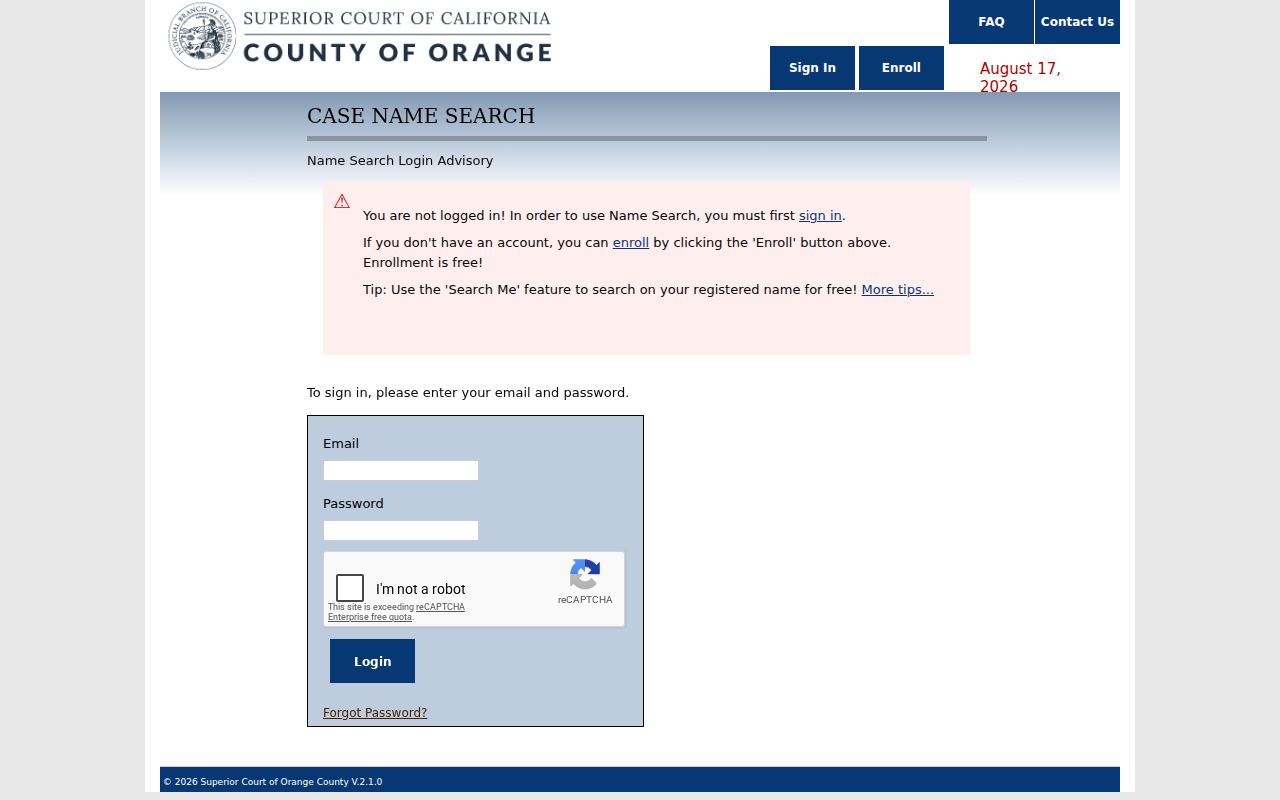
The Superior Court of California, County of Orange, handles Huntington Beach civil, criminal and traffic, family, probate, and small claims matters. The Case Access gateway separates those categories and directs a searcher without a case number to the paid Case Name Search. The name service requires a Sign In or Enroll step before credits can be used.
| Control or field | Type | Use | Research note |
|---|---|---|---|
| Sign In / Enroll | Account control | Required before paid searches | New users enroll through the name-search service. |
| Search subject | Person or Business radio choice | Selects identity mode | Business names need a separate interpretation from person names. |
| Last Name / Business Name | Required text | Starts the name query | Use exact spelling first, then controlled variants. |
| First Name | Conditional text | Narrows person mode | Keep initials and name variants in the research note. |
| Middle Name | Optional text | Separates namesakes | Use when a record exposes it. |
| Case Type | Category selection | Narrows civil, criminal, family, probate, or small claims | Availability depends on the case-access category. |
| Date or year range | Optional filter | Reduces common-name results | Particularly useful for historical indexes. |
| Search / Reset | Buttons | Runs or clears the search | Credits are charged under the displayed fee schedule. |
The fee schedule effective January 1, 2026 lists web Public Name Search at $1.50 for one credit, $5 for five, $9 for ten, $70 for 75, or $400 for 30-day unlimited access. Civil document access is $7.50 for the first ten pages, $0.07 for each later page, and capped at $40 per document. Probate, Family Law, Small Claims, civil-harassment, confidential, and sealed material are excluded from the imaged-document program described by the court. An absent online result can reflect an old index or confidentiality rule.
The court capture from Orange County Case Name Search shows the portal route used to separate a person or business name before a case number is known.
For a criminal file, use copy form L-3009 at the filing clerk’s office or by mail. Supply the defendant name, case number, date of birth and driver-license number if known, exact documents, and a telephone number. Mail requests use a check payable to Clerk of the Court and a self-addressed stamped envelope. The court says requests generally take 7-10 working days. Older indexes are held at the respective Justice Centers. Federal cases use PACER for the Central District of California, not the county portal.
Verifying a Huntington Beach Resident Across Records
A defensible resident lookup moves from a name to a stable key, then to a second custodian. The goal is not to collect every possible detail. It is to answer one defined question and state what the public record actually supports.
- Anchor the name to a known parcel, dated address, organization, or family relationship. Use property and permit sources for an address question, not a court search chosen at random.
- Run the Orange County court search with the right division, name variants, middle name, and date range. Save the case number and party role.
- Compare the result with an independent source. A deed party plus APN is stronger than either name alone. A license number plus board record is stronger than a business address alone.
- Order the underlying record when the fact matters. The recorder index omits the deed image, a docket is not the complete court file, and an informational vital copy is not an identity certificate.
- Write the result as a dated fact, such as “listed as grantee on instrument number” or “appears as a party in case number,” rather than saying the person lives at an address now.
- Docket
- The court’s running record of filings, events, hearings, and status in a case.
- Index versus image
- An index gives a searchable pointer and fields. An image or filed copy is the underlying document and may carry a separate fee or access rule.
- Certified copy
- A copy issued and certified by the custodian as a true copy for a use that requires formal proof.
- Party role
- The legal or record position attached to a name, such as grantor, plaintiff, fiduciary, licensee, or defendant.
| Name and role | The person or business name and the role assigned by the custodian. |
|---|---|
| Durable number | Case, instrument, parcel, license, booking, or CDCR number when the record provides one. |
| Date | Filing, recording, issue, booking, or event date tied to the result. |
| Record type | Case category, document type, license class, parcel record, or custody system. |
| Access status | Index only, image available, copy fee, redaction, sealed file, or other stated limit. |
The sample result inventory to preserve is small: name and role, case or instrument number, filing or recording date, record type, court or parcel, linked document status, and any stated redaction or access limit. The narrow record is easier to verify than a large collection of uncertain details.
Huntington Beach Vital Records and Copy Types
Birth, death, and marriage records follow a separate custody path. The Orange County Health Care Agency Office of Vital Records is the local route for recent county births and deaths. Its office is at 200 W. Santa Ana Blvd., Suite 100-B, Santa Ana, CA 92701, Monday through Friday, 8:00 a.m. to 4:00 p.m. except holidays, phone (714) 480-6700. OVR asks applicants to allow ten business days after an event before applying and will not verify by phone or email that a record is ready.
For 2026, the researched county fees are $34 for a birth record, $26 for a death record, and $19 for a marriage record. The Orange County Clerk-Recorder issues county birth, death, and marriage copies, while California Department of Public Health Vital Records is the statewide mail channel. CDPH recommends the county health department or recorder for births and deaths during the first three months, and the county recorder for marriages during the first six months, because state receipt can lag.
California distinguishes an authorized certified copy from an informational certified copy. The informational copy is marked not valid to establish identity. Authorized access follows Health and Safety Code §§103526 and 103526.5 and requires a qualifying relationship or authority. Confidential marriage records are narrower under Family Code §509: there is no informational copy, and access is limited to a named spouse or party or another qualifying legal route.
CDPH’s public marriage certificate service currently covers 1905-1999 and 2008-2023. A recent or out-of-range event should be routed to the Orange County Clerk-Recorder. State paper applications identify birth VS 111, death VS 112, marriage VS 113A, and dissolution VS 113B. Mailed authorized requests require the stated sworn statement and notarization rules, with payment to CDPH Vital Records. A divorce decree remains a Superior Court record; a CDPH dissolution certificate is only an abstract.
Note: Vital indexes and certificates can confirm an event, but eligibility, copy type, redaction, and the issuing custodian determine what a requester may receive.
Huntington Beach Voter Status Is Authenticated
California’s voter tools are designed for a registrant to check their own status, not for a casual resident lookup by street or name. The My Voter Status form asks for first name, last name, full date of birth, and either a California driver license or identification number or the last four Social Security digits. The Orange County voter tool also asks for the first three letters of the first name. A new online registration should be given at least 24 hours before checking.
The capture comes from the Orange County voter-data application route, where controlled file access is separated from personal authentication.
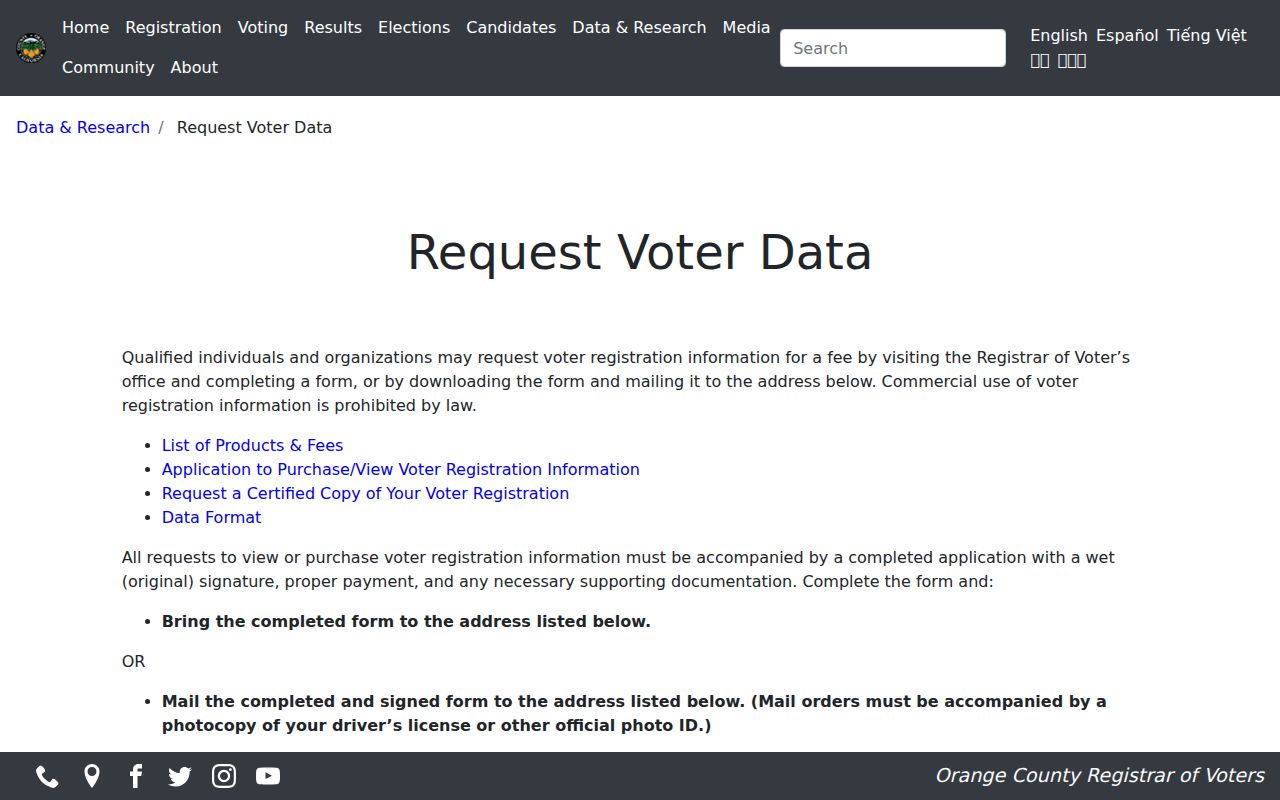
Orange County Registrar of Voters is at 1300 South Grand Avenue, Building C, Santa Ana, CA 92705, phone (714) 567-7600. A controlled voter-file application requires an original wet signature, current photo ID, a stated purpose, security measures, and supporting detail. Email and fax are not accepted. An application about a specific person must supply identifying facts and justification and is capped at ten voter records. A standard countywide file is listed at $37 electronically, and a customized file at $80 electronically; a printed walking list uses the order form’s page-based pricing.
Approved file fields can include voter ID, name, residence and mailing address, party preference, date of birth, registration date, mail-ballot status, supplied phone or email, precinct, and participation history. Participation history shows whether and how a ballot was cast, never the ballot choice. Home street address, phone, email, prior registration, signature, and unique identifiers are protected outside the controlled process under Elections Code §§2188, 2194, and 18109, Government Code §7924.000, and 2 CCR §§19001-19013.
Huntington Beach License and Entity Trails
Professional and business records can clarify a public affiliation without turning an office address into a residence claim. The California Department of Consumer Affairs search accepts Boards and Bureaus, License Type, License Number, Business Name, First Name, Last Name, and Registry Number. Results can show whether a credential is current, expired, suspended, revoked, or otherwise disciplined. A board-specific search may be needed for contractors, physicians, nurses, educators, attorneys, or other fields.
California Secretary of State bizfile Online searches corporations, LLCs, limited partnerships, and nonprofits by entity name or file number. Advanced Search adds entity type, status, and initial-filing-date filters. Free recent statements and filings can show an entity number, status, addresses, agent, managers or officers appearing in filings, and filing dates. LLPs and general partnerships require another route. Orange County fictitious business name filings identify registrants behind a trade name, but a DBA is not proof of licensure.
The State Controller’s unclaimed-property search accepts a last or business name or Property ID, with first name, city, and ZIP Code as narrowing fields. Search and claim are free, but a claimant must prove ownership. Exact matches display first, followed by similar names. A Huntington Beach city filter can be a useful locality clue, yet the locality may be old and should not be treated as a current address.
For a business or license question, preserve the license or entity number, name, address type, issue or expiration date, and the board or filing source. That inventory makes a second check possible and avoids merging a licensee, agent, owner, and resident into one identity.
Huntington Beach Custody and Registry Checks
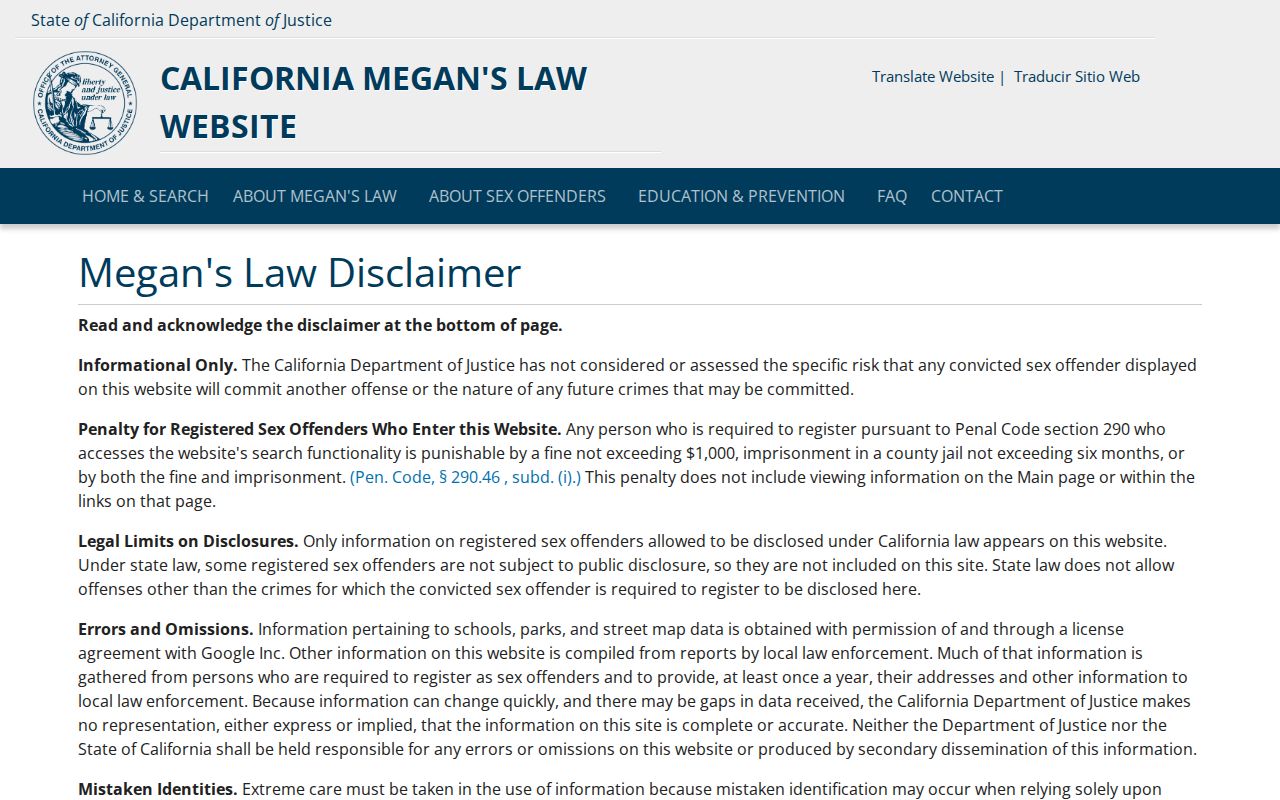
Custody systems answer a narrow question and change fast. The Orange County Sheriff’s Inmate Information System and booking log cover county custody. The California Department of Corrections and Rehabilitation locator covers state-prison custody and uses a CDCR number or name. The California Megan’s Law site offers name and geographic searches, but public display varies by statutory category and can show a full address, ZIP only, undisclosed location, or no public profile.
The registry capture comes from the official California registry, whose warnings and posting categories are part of interpreting a result.
An OC Sheriff booking entry is not a conviction. Confirm disposition through the Orange County Superior Court case number when available. A CDCR result is not a complete criminal-history record. A registry map absence does not prove that no registrant is present because some people are displayed by ZIP, undisclosed, or omitted by law. Do not confront anyone based on a locator or registry result.
Human Uses for Huntington Beach Residents
Official records can support a family-history or reconnection task when the search has a defined purpose. Probate filings and recorded transfers can help reconstruct an inheritance trail. The court petition or order, not a surname match, establishes the relationship actually alleged or adjudicated. A dated directory, yearbook, local newspaper, or obituary can help reconnect with a former classmate or military friend without turning a historical clue into a current-contact claim.
For a seller or entity question, compare the claimed name with the recorded owner or business filing, the license number, and the filing dates. For a historical trail, the Huntington Beach directory collections add older names and addresses that modern portals do not hold. For a known street where the question shifts to nearby parcels, use the address-led Huntington Beach street directory workflow.
Each use keeps disclosure proportionate. Record the fact needed for the question, the date, the office, and the durable identifier. Avoid compiling a living person’s full address, birth date, relatives, and sensitive case details when a smaller answer will do.
Huntington Beach Resident Lookup Privacy
Some gaps are intentional. California’s Consumer Privacy Act, as amended by the CPRA, gives qualifying consumers rights to know, access, correct, delete subject to exceptions, limit sensitive-data use, and opt out of sale or sharing. The California Privacy Protection Agency’s Delete Request and Opt-out Platform, known as DROP, launched January 1, 2026. A resident verifies through the California Identity Gateway or Login.gov, creates a profile, and sends one free request to more than 600 registered brokers. Brokers retrieve requests at least every 45 days, and status can take up to 90 days.
DROP affects commercial compilation, not the underlying Orange County deed, court, assessor, or election custodian. A mistaken profile outside DROP should be handled through the publisher’s own privacy route with the minimum matching data needed. California’s DROP information explains the request and status process. Safe at Home, administered by the California Secretary of State, gives qualifying victims and protected participants a substitute mailing address and limits public display of a home address, phone number, or image under Government Code §6208.1.
Lawful use. A Huntington Beach resident lookup is for personal, lawful research, genealogy, reconnection, and defined record verification. Do not use records to stalk, harass, threaten, impersonate, intimidate, or evade a confidentiality program. California Penal Code §646.9 and Code of Civil Procedure §527.6 address serious harassment and stalking conduct.
Voter, vital, court, law-enforcement, and DMV data have their own restrictions. The California Public Records Act, Government Code §§7920.000-7931.000, helps request identifiable existing administrative records, but it does not override a sealing rule or require an agency to build a custom resident profile.