
Huntington Beach City Directory Holdings by Year
Historical city directories help connect a name, an address, and a moment in Huntington Beach without pretending that any single listing tells the whole story. Their value comes from comparing how an entry is organized, what the volume says about its coverage, and which independent record can confirm the same detail. The most useful approach considers local volumes, regional books, telephone issues, reverse sections, digitized collections, and related historical sources together. A missing listing may reflect an access or coverage limit rather than proof that a household, address, or business did not exist.
| Collection | Verified years | Where held or described | Access and caveat |
|---|---|---|---|
| Huntington Beach local volume | 1951 | U.S. City Directories collection; Ancestry Library Edition and FamilySearch paths | Indexed online; exact Central Library shelf run was not located |
| Santa Ana, Orange, Huntington Beach, Balboa Island, Newport Beach, Costa Mesa regional directory | 1941 | OCCGS catalog and Ancestry Library Edition research routes | Exact publisher and shelf call number remain unverified |
| Pacific Telephone books | March 1935-December 1948; November 1955-November 1958; individual November 1959-1961 | Library of Congress telephone-directory collection | Image access can vary by rights and onsite rules |
| Modern and reverse EDR abstracts | 2010, 2014, 2017, 2022 | 2025 Huntington Beach environmental report; publishers named include Cole, Pacific Bell, Haines, R.L. Polk, Luskey Brothers, and Home Directory Service | Confirms a report’s address research, not public library ownership |
| Orange County directories | Not itemized on the official page | Orange County Archives | Ask archivists to identify titles and years before a visit |
| United States City and Business Directories | Approximately 1749-1990 nationwide | FamilySearch collection | Local years depend on indexed holdings and search terms |
The gap is important. No authoritative finding aid located in the research run gives an exhaustive publisher-by-publisher sequence, exact call numbers, or a last printed Huntington Beach year. The confirmed dates are useful starting points, not permission to fill an unverified year with a guess.
Where Huntington Beach Directory Research Happens
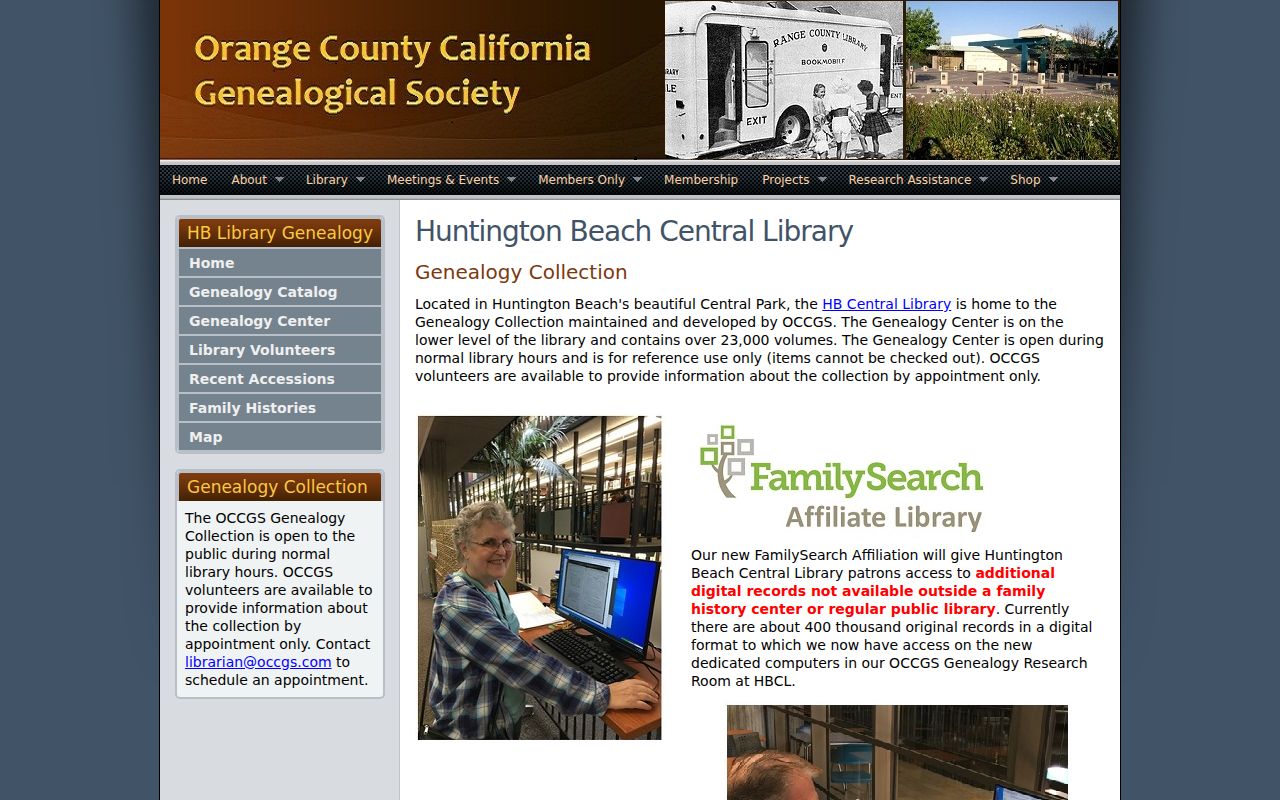
The strongest local shelf is the Orange County California Genealogical Society Genealogy Center on the lower level of Huntington Beach Central Library, 7111 Talbert Avenue, Huntington Beach, CA 92648. The OCCGS library page describes more than 23,000 reference volumes, normal library-hour access, and volunteer help by appointment through librarian@occgs.com. Material is arranged first by subject and then by geography, so an Orange County or Huntington Beach volume may be filed with California, county, or city material rather than under a title guessed from a web search.
The library capture from OCCGS’s local genealogy source shows the kind of physical research setting that complements online indexes.
Subject groups include census records, directories, military records, family histories, maps, research aids, and periodicals. OCCGS also keeps surname-card and family-history traditions, but the current catalog and recent-accession lists should be checked in person. The society can arrange collection help, yet it does not promise an unlimited remote search for a name.
Central Library is a FamilySearch affiliate. Dedicated computers in the research room can reach about 400,000 digitized originals that may not open from an ordinary home connection. Access varies by collection and login. Some images require a free FamilySearch account, an affiliate computer, or a FamilySearch center. Huntington Beach centers are at 8702 Atlanta Avenue, 92646, phone (714) 536-4736, and 5402 Heil Avenue, 92649-3289, phone (714) 330-1306. The centers offer trained help as well as gated partner access. These are separate access channels, not alternate claims that every image is freely open online.
Digitized Huntington Beach City Directories
The 1951 Huntington Beach volume is specifically indexed through the U.S. City Directories collection. Ancestry Library Edition can be used at a participating library, while FamilySearch’s United States City and Business Directories collection offers First Names, Last Names, Birth Place, Birth Year, and More Options fields. The result depends on what has been digitized and indexed. A search form is not proof that a complete local shelf was scanned.
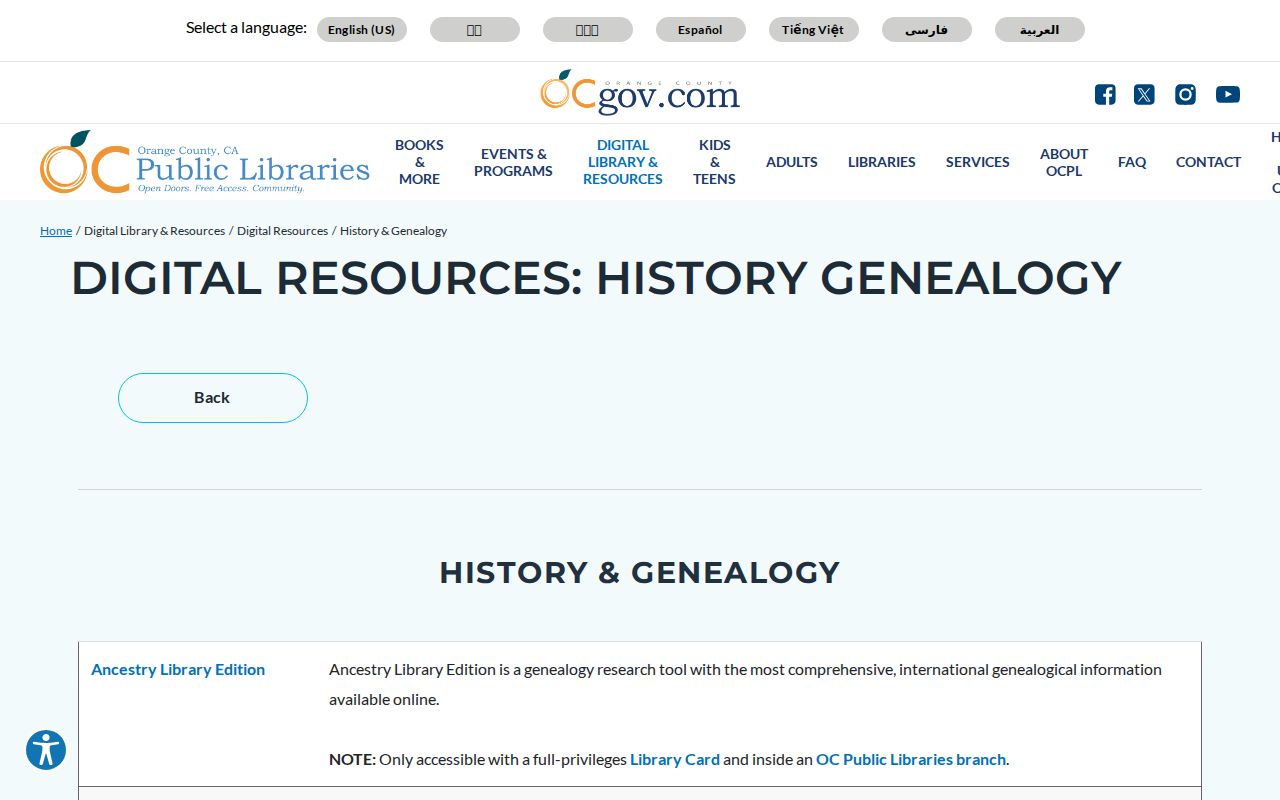
The Orange County Public Libraries history and genealogy resources add branch-based tools. Ancestry Library Edition is restricted to an OCPL branch. Full-privilege cardholders can use Fold3 and HeritageQuest. OCPL also provides selected digitized newspaper microfilm from the 1920s through 2021 and NewsBank access to the Orange County Register from 1987-current for eligible cardholders.
The library capture from OCPL’s history and genealogy access path belongs beside the directory search because newspapers and local indexes often fill a missing edition or explain a move.
Telephone issues have a separate route through the Library of Congress telephone directory collection. Rights or onsite rules can limit image access, so a cataloged issue is an identified source, not a promise of a downloadable page. The 2025 city-filed environmental report is another valuable path: its address abstract names publishers and lists subject and adjoining addresses for 2010, 2014, 2017, and 2022. It verifies professional address research, not public library ownership of those editions.
Reading a Huntington Beach City Directory Entry
A city directory entry is a compact set of clues. Traditional alphabetical pages may give a surname, given name or initial, spouse, occupation or trade, and residence address. Reverse pages begin with a street and number, then list a subscriber or occupant. Owner or renter marks appear only when a particular volume uses them. The front matter matters as much as the name because symbols and abbreviations must be read through that volume’s own key.
| Printed name | Surname, given name or initial, and sometimes a spouse in parentheses. |
|---|---|
| Occupation or employer | A historical identity clue, when printed, that can help separate people with the same name. |
| Address | House number and street in an alphabetical or street-order section. |
| Owner or renter mark | Present only in runs that use the mark; confirm its meaning in the key. |
| Listed occupant | The person or institution printed for that edition, which may not be every household member. |
- Criss-cross section
- The street-order half of a volume. It reverses the name-first search so an address can lead to a listed subscriber or occupant.
- Householder index
- An index organized around a household or principal name. Its coverage and meaning vary by publisher.
- Abbreviation key
- The volume’s explanation of short forms and symbols. Photograph or transcribe it before interpreting an entry.
- “No listings”
- A result in the consulted publication. It is not proof that a building was empty or that no person used the address.
The modern abstract in the city-filed environmental report makes the same caution visible. It groups “listed occupant(s)” by year, includes institutions and numerous individuals, and reports “No listings” for 2017 at the studied location. The statement describes that source’s result only. It does not settle occupancy for the year.
Alphabetical Huntington Beach Directory Searches
Two passes work better than one. Start with the alphabetical section when a surname, given name, spouse, or occupation is known. Then reverse the search by street and number. The second pass can catch a subscriber whose name was printed with an initial, a different spelling, or an abbreviated form. It can also show nearby entries that help test whether the address belongs to the right block.
- Copy the title, publisher, edition year, page number, and front-matter key before searching.
- Search the exact surname and likely spelling variants, then record spouse, trade, address, and every mark without expanding an abbreviation.
- Use the street-order pages for the house number and nearby numbers. Compare the sequence with a map, plat, or parcel record if the street has changed.
- Mark the result as a printed listing for that edition. Confirm ownership through deeds or assessment records and confirm later identity through an independent source.
A telephone directory also has a built-in omission rule. It generally reflects listed subscribers, not every household. A move, name change, death, nonpublication, or an unlisted number can all break the sequence. The absence of a name deserves a follow-up search, not a conclusion about the person.
Tracing a Huntington Beach Household Through Editions
Family-history work is strongest when each edition is treated as a dated snapshot. Begin with the most certain year and spelling, then move one issue at a time. Keep a separate line for address, spouse, trade, and source page. When a printed find needs current official corroboration, a Huntington Beach resident lookup can test the name against modern court, license, property, and vital-record channels without pretending that a historical listing proves a present address.
- Find the first reliable appearance in an alphabetical section and copy the entry exactly.
- Check the next available issue, noting a move, spouse change, new initial, or altered street form.
- Turn to the reverse section for the address and nearby households. Keep the printed page and edition with the note.
- Pair the directory year with the nearest public census. The 1900-1950 schedules provide household relationships and ages, but address numbering and enumeration boundaries must be reconciled.
- Close a gap with newspapers, an obituary, a permit, a deed, probate, or a cemetery record, and write the conclusion with its date and source.
Disappearance has many explanations. A person may have moved, died, married, changed a name, served in the military, skipped an issue, used an unlisted number, or simply fallen outside the publisher’s coverage. The next or prior edition, an obituary, and the census household can separate those possibilities. A directory proves a printed listing; it does not prove ownership.
Huntington Beach Directories Beside Census and Obituaries
The gaps between directory years are where companion records earn their place. The National Archives census guidance makes 1950 the newest public federal population schedule under the 72-year rule, while 1960 is scheduled for release in 2032. The 1950 population side survives with enumeration maps and descriptions, but the reverse-side dwelling schedules were not microfilmed and the paper originals no longer exist.
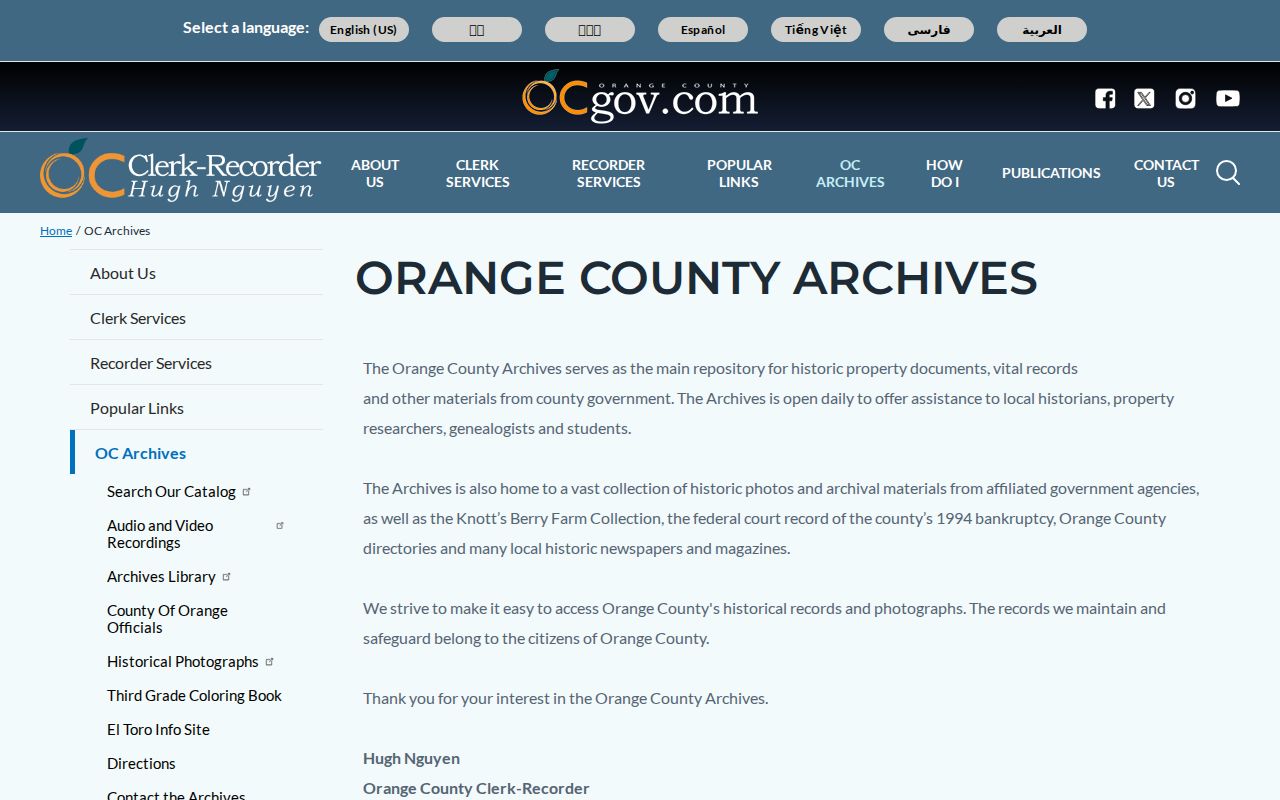
The Orange County Archives is a second historical route. Its official entry point lists historic county property and vital material, directories, photographs, newspapers, and magazines, with most holdings dating before 1960. The archive capture from that source points to the research route. Ask for a specific series, title, and year because the public page does not itemize the full local directory run.
OCCGS’s digitized 1890 Orange County Great Register can act as a census substitute, but it is a voter register and disproportionately reflects eligible male citizens of that era. The cemetery index intentionally stops after February 1978 and omits some inscription detail, so the original books or PDFs matter. OCPL’s obituary guide points to the California Death Index for 1940-1997, the Social Security Death Index, NewsBank and Obits Archive after January 1, 1987, and older Orange County Register microfilm.
Note: A directory, census, obituary, and cemetery index can reinforce one another, but each has its own date range, selection rule, and transcription risk.
Huntington Beach Directory and City History Timeline
Local geography explains why a directory trail changes shape. The dates below are research anchors that help choose a repository and interpret a printed address.
- 1889: Orange County formed from Los Angeles County, changing the county custodian for later records.
- 1909: Huntington Beach incorporated, and the Library of Congress holds a four-sheet January 1909 Sanborn map for the early town.
- 1930: Part of the numbered-street oil-field area appeared in the census as “Standard Oil Company Camp,” a clue to company-controlled lodging and unusual household patterns.
- 1935-1948: Pacific Telephone issues anchor an older local subscriber run, followed by additional 1955-1961 issues.
- 1941 and 1951: The regional directory and the specifically indexed 1951 local volume provide confirmed mid-century search anchors.
- 1957-1960: Large annexations expanded the city from 3.57 square miles to more than 25 square miles, changing which local office created later records.
- 2010-2025: Modern address abstracts for 2010, 2014, 2017, and 2022 appear in a 2025 city-filed environmental report, while the city’s current GIS and WebLink preserve newer address and document context.
The timeline is not a claim that every year between those anchors survives. It is a way to avoid forcing a 1951 city label onto a 1941 regional volume or treating a post-annexation city file as proof of earlier municipal custody.
Huntington Beach Names in the Historical Shelf
Older Huntington Beach research may use a place name that no longer appears on a current search form. Wintersburg and Oceanview describe an earlier Japanese-American agricultural settlement and community history. The city’s Historic Resources Survey also separates early agriculture, the beach resort, the oil boom, surf culture, civic infrastructure, religion and culture, commerce, World War II, and postwar growth. Search those terms beside a surname, street, institution, or tract instead of relying on Huntington Beach alone.
The January 1909 Sanborn map is a compact early baseline. It can show building footprint, use, construction, and block context, but it does not name every person. Later permits, deeds, directories, and newspapers supply the people layer. The 1930 Standard Oil Company Camp label is another reminder that a printed address may describe a boarding house, company lease, or shift-based lodging rather than a conventional family home.
Postwar annexations and Huntington Harbour’s canals add more geography. The city’s Historic Resources Survey records those changing contexts. A nearby number may sit across a waterway or in a different tract, while an older county record may use a rural or community label. Parcel maps and the legal description keep those variants tied to the right place.
Limits of a Huntington Beach City Directory
A city directory is a publication, not a certified identity record. It can show that a name, subscriber, institution, or listed occupant appeared in a stated edition. It cannot by itself prove that the person owned the address, stayed there for the full year, lived there now, or was the only member of the household. “No listings” can mean a gap in the volume, an unlisted number, a publisher choice, an address change, or a record that was not captured.
The confirmed 1941 and 1951 anchors, telephone runs, modern EDR abstracts, and Orange County Archives listing should be reported with their source and access conditions. The missing exhaustive shelf inventory is part of the answer. A librarian or archivist can confirm a title and year that an online index does not expose; a result that cannot be reproduced should remain a lead.
For family history, combine the printed line with a census household, obituary, cemetery entry, deed, permit, or probate file. For a current question, switch to the official custodian that matches the fact being tested. A careful Huntington Beach city directory search is valuable because it preserves a dated human trace while respecting what the book never set out to record.